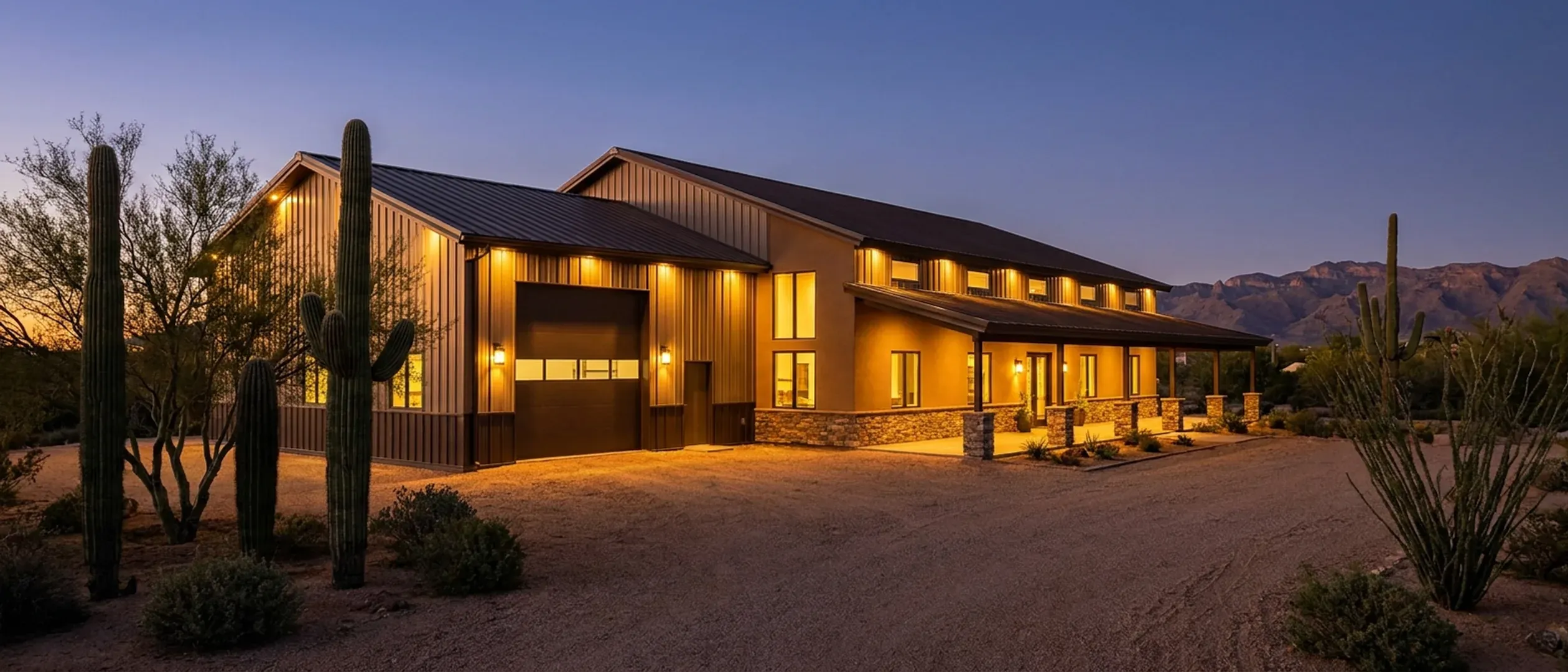
A barndominium at dusk on desert acreage, warm light in every window, with saguaro silhouettes and a mountain range on the horizon.

Barndominium builders in Arizona

Arizona barndominium kits, custom floor plans and metal building homes, from the low desert around Phoenix, Tucson and Yuma to the snow country around Flagstaff and the White Mountains. A barndominium in Arizona starts where Arizona land deals start: with the water, then the parcel, then the plan. We build it, or supply the kit for you to finish.

Low desert to high country, seven regions
Steel kits, metal building and post-frame homes
Kits, shells and turnkey builds
Water and the parcel checked first

Barndominium kits, plans and builds for Arizona

Most people looking for barndominium builders Arizona-wide are really asking three things: what to build, what it comes as, and who puts it up. We draw the plan, supply the barndominium kit, and build it turnkey, or stop at the shell and hand the finish to you.

Know which of these you want? A plan drawn for your land is where it starts.

Before you buy land in Arizona

The questions that decide an Arizona barndominium are rarely about the floor plan. They are about whether the land has water, which climate you are building in, and what the frame is made of.

Where can I buy buildable land with water?

In Arizona, water decides whether a parcel is buildable, and it is the question to answer before you buy. Land may be served by a city or private water provider, have a working well, be able to have a new one drilled, or depend on water hauled in by truck.

Arizona regulates groundwater by area. The Arizona Department of Water Resources lists eight Active Management Areas: Phoenix, Pinal, Tucson, Prescott, Santa Cruz, Douglas, Willcox and Ranegras Plain. Inside one, a new subdivision needs a certificate of assured water supply, a 100-year supply, or service from a designated water provider (A.R.S. § 45-576); since June 2023 the state has not approved new groundwater-based assured water supply determinations in the Phoenix AMA. Outside the AMAs, the subdivider must have the supply judged adequate or inadequate, and an inadequate supply has to be disclosed.

Those programs apply to subdivisions, which in Arizona means six or more lots. A rural parcel from a lot split of five or fewer is not a subdivision, so it comes with no water determination at all: confirm the well, the provider or the hauling, and the legal access, before you buy. A household well with a pump of 35 gallons a minute or less is an exempt well (A.R.S. § 45-454), and outside an AMA a notice of intention to drill is filed with the department before any well is drilled.

Arizona State Trust land is another route to a parcel: it is sold only at public auction, after an appraisal and at least ten weeks of published notice (A.R.S. §§ 37-236 and 37-237). On tribal trust land the tribal government has jurisdiction, not the state or the county. If your parcel is on or next to tribal land, say so in the survey and we start there.
Low desert or high country?

Arizona is really two building climates. In the low desert around Phoenix, Tucson, Yuma and the Colorado River towns, the design problem is heat: long summers, monsoon storms that bring wind and blowing dust, and ground where frost is rarely the concern.

In the high country around Flagstaff, Show Low, the White Mountains and the Mogollon Rim, the problem turns to snow and freeze. A roof, frame and foundation that suit Buckeye are not automatically right for the Colorado Plateau.

We size the roof, frame and foundation to the wind, snow and frost values the permit office over your site uses, and in the desert we put the effort into insulation, roof finish and orientation, which do most of the work of keeping a building cool.

Why steel?

For most Arizona land we recommend a steel frame, and the reasons are practical. Steel does not rot or warp, termites do not eat it, and a steel frame spans wide open floors and tall shop bays without interior posts.

Metal roofing and wall panels shed a monsoon downpour, and a light, reflective roof finish turns back much of the sun. The trade-off is that steel conducts heat readily, so in the desert the insulation and the breaks between frame and interior matter more, not less.

Wood post-frame, the pole barn home, is still an option where it suits the site and the budget. We will talk through both.

How a build runs

Land to keys, in four stages

Barndominium projects go wrong early, at water, zoning, septic and access, long before anyone pours concrete. Here is the order that avoids that, and who does what.

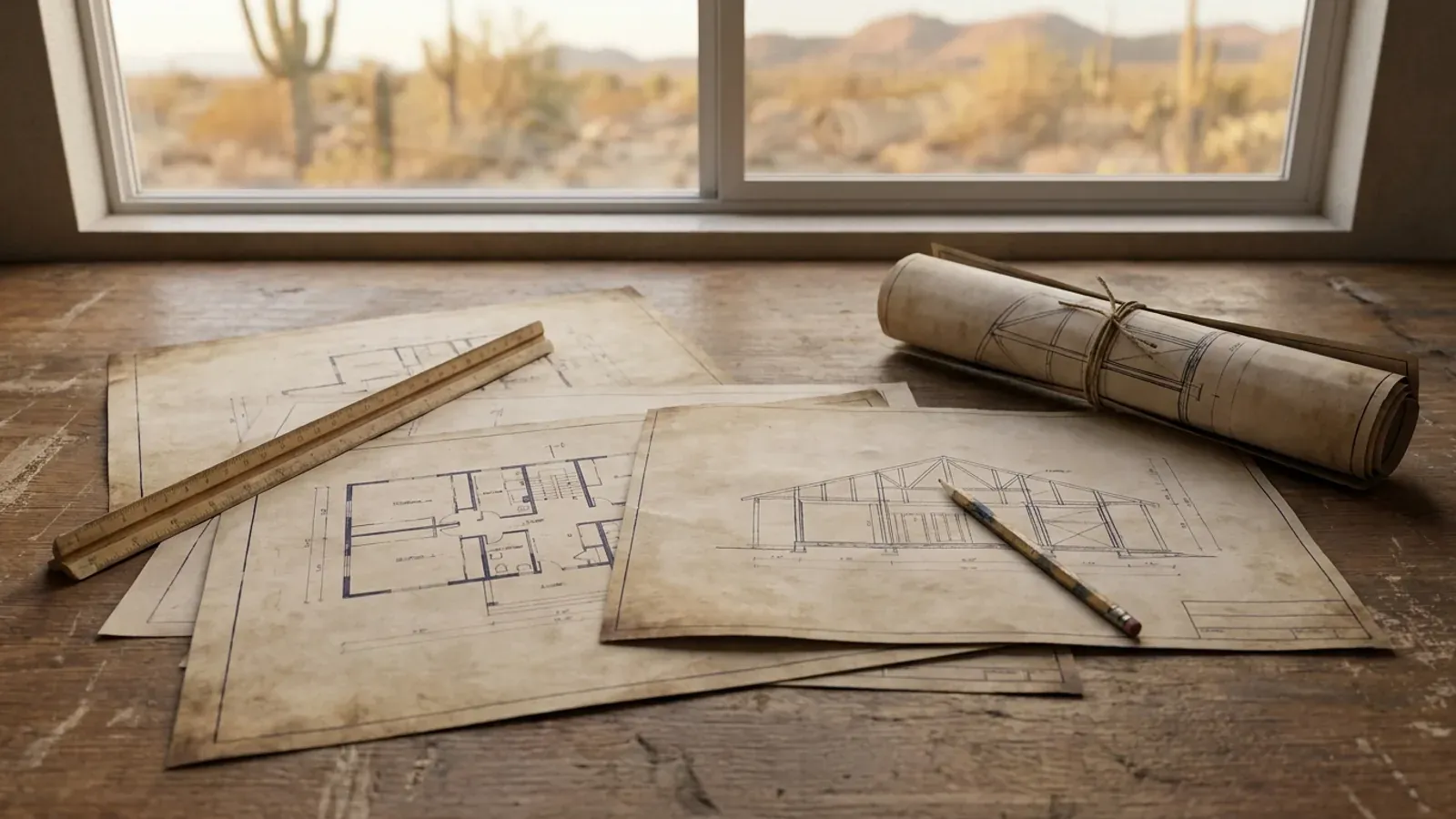
Overhead view of barndominium floor plan and structural elevation drawings spread on a workbench with a scale ruler and pencil.
1

Start your plans

Start the survey. We take your program, the rooms, the shop bay, how you actually want to live in it, and start a floor plan drawn for you rather than pulled off a shelf. This is the first real step and it is where most of the useful decisions get made.

That is how a build runs. Step one is a plan drawn for your land, and that starts with a conversation.

Barndominiums across Arizona

We work with landowners in seven regions and 43 cities and counties, from the Valley and the Tucson basin to the Colorado Plateau, the Mogollon Rim country and the Colorado River towns. Water, zoning, septic and permits are handled by different offices from one place to the next, so every project starts with the parcel, wherever it is.

Building in Arizona: common questions

11 questions we get asked most often about building in Arizona. If yours is not on the list, ask it directly.

Do you build barndominiums across Arizona?
Yes. Arizona Barndominium Builders draws barndominium plans, supplies barndominium kits and builds metal building and pole barn homes for land across Arizona: Phoenix and the Valley; Pinal County and the Southeast Valley; Tucson and Southern Arizona; Flagstaff and Northern Arizona; Prescott, Payson and Central Arizona; Kingman, Lake Havasu and Yuma; and Safford and the Gila Valley. See the areas we serve, or start the survey with your parcel.
Do you sell barndominium kits in Arizona, or only full builds?
Both. You can buy a barndominium kit or a dried-in shell from us and finish it yourself or with your own crew, or have us build it turnkey, from the pad to the keys. Arizona law lets property owners build their own home themselves, with their own employees or with licensed contractors, when it is for their own occupancy and not for sale or rent; selling or renting it within a year of completion is treated as evidence it was built for sale (A.R.S. § 32-1121(A)(5)). On a kit we supply without installing, installation may also be performed by a licensed contractor; ask us for the name and address of one. Tell us which way you are leaning in the survey and we will set out what each option covers on your parcel.
What is the difference between a barndominium, a metal building home and a pole barn home?
Barndominium describes what the building is: a home, usually open-plan and often with a shop or garage bay under the same roof. Metal building home, post-frame home and pole barn home describe how it is built. A metal building home usually means a steel frame with metal wall and roof panels; a post-frame or pole barn home is carried on large wood posts spaced wide apart, with girts and purlins running between them. A barndominium can be either, and for most Arizona land we recommend steel.
How much does it cost to build a barndominium in Arizona?
We do not publish a price list, because on a barndominium the land moves the number more than the floor plan does: where the water comes from, the pad, how far power has to run, whether the parcel needs a septic system, and what the permit office over it asks for. Our guides include a cost guide that sets out published third-party cost data with its sources. For what drives the number on your own parcel, start the survey.
Can I build a barndominium on land without city water?
Often, but it is the first thing to check, and it is worth checking before you buy. A rural parcel may have a working well, be able to have a new one drilled, or depend on hauled water. Groundwater rules depend on whether the land is inside one of the Arizona Department of Water Resources' Active Management Areas, and a household well with a pump of 35 gallons a minute or less is an exempt well (A.R.S. § 45-454). A parcel from a lot split of five or fewer lots is not a subdivision under Arizona law, so no state water determination comes with it. Where the home will rely on hauled water, check the county's rules and where the nearest fill station is. Send us what you know about the parcel through the survey and we will start with the water.
Who issues the building permit for a barndominium in Arizona?
It depends on where the parcel is. Arizona has no statewide residential building code: cities and towns adopt their own, and inside city or town limits their building department issues the permit. On unincorporated land, a county that has adopted zoning may adopt a building code, and it may exempt areas zoned rural or unclassified (A.R.S. § 11-861(A)), so some rural land has no building permit requirement at all. A steel or post-frame kit erected on site is a site-built home under that local code, not a state-inspected factory-built building. The answer can change at a city limit, so we confirm the office for your exact parcel before anything is filed. Zoning, minimum lot size and the septic permit are part of the same check. On a mapped floodplain, building needs written authorization from the county flood control district (or the city, where it manages floodplains), and the lowest floor must sit at or above the regulatory flood elevation. On tribal trust land the tribal government has jurisdiction.
Does a barndominium on rural land need a septic permit?
Where there is no sewer, yes, and it is planned before the house is placed on the lot. A conventional system, a septic tank with a trench, bed, chamber or seepage pit, falls under the state's Type 4.02 general permit (A.A.C. R18-9-E302). It starts with a site investigation that includes percolation testing, and a Construction Authorization comes before the system is built. State law lets the Department of Environmental Quality delegate this work to a county (A.R.S. § 49-107), so the office you deal with depends on the county. Soil, slope, lot size and the size of the home all shape the system, which is why we site the septic system and the house together.
Does snow or heat change how a barndominium is built in Arizona?
Both do, depending on where you build. The high country around Flagstaff, the White Mountains and the Mogollon Rim gets real snow, while the low desert is about heat, monsoon wind and dust. The roof and frame are sized for the design values the permit office over your site uses, and in the desert insulation, roof finish and orientation carry most of the load. That is one more reason the parcel comes before the plan.
Can I finance a barndominium in Arizona?
Usually, though lenders do not all handle them the same way. Most barndominiums are financed like a custom home, often with a construction-to-permanent loan, and the appraisal can be the hard part where there are few comparable sales nearby. Talk to lenders early, and see our guides for a fuller walk-through.
Can a barndominium be a shouse, a shop with living quarters?
Yes. A shop house puts a working shop, equipment bay or RV bay and the living space under one roof, and it is one of the most common reasons people choose a barndominium. The shop door size, the ceiling height in the bay and how the living space is separated from it are the decisions that shape the plan, and the permit covers the whole building, shop included.
How do I get started?
Start the survey. It asks where the land is, what you want to build, roughly how big, and whether you want a kit, a shell or a turnkey build. That is enough for us to come back with the questions that matter for your parcel, and there is no charge for that conversation.

Got land in Arizona? Tell us about it.

Start the survey with your parcel, or the one you are thinking of buying, and we will come back with what can be built on it, where the water comes from, and what drives the cost. No charge for that conversation.